Myobrace in Toronto at Archer Dental – Straighten Childrens’ Teeth Without Braces
Archer Dental now proudly offers Myobrace®, a no-braces approach
to straightening children’s teeth and jaws.
 That’s right, no braces.
Myobrace focuses on treating the underlying causes of children’s
crooked teeth by gently re-aligning and correcting less than
optimal bites and jaw alignments in their younger and slightly more
malleable mouths.

Child holds his custom fit Myobrace
The same principles can also be applied to correct bites in
older people, but the device and practice is slightly different
(next month, we’ll also be writing about Myosa).
Trusted by reputable dentists and orthodontists in almost fifty
countries around the world, Myobrace has already successfully
treated millions of children, and is now available at all three
Archer Dental locations in Toronto, Canada.
Nature vs Nurture as it relates to Crooked Teeth
There is a great debate raging in dental circles about what
really causes crooked teeth. Is it genetics, as we always believed,
that leaves people helpless to their body’s dental development?
Or is having a misshapen mouth as a teenager the result of inferior
breathing habits learned in early childhood? There are arguments on
both sides but dentists at Archer Dental are now leaning toward the
latter.
It’s common for parents and grandparents to look at their
small children and recognize their own noses and eyes, and their
own crooked teeth. At the same time, parents often scold toddlers
for sucking their thumbs which they believe, and which many
orthodontists have told them, is a leading cause of ‘buck
teeth’ and misaligned mouths. So, which is the true culprit? Or
is every case different and perhaps genes and behaviour are both
factors?
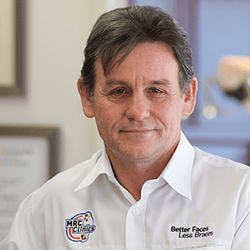
Dr Chris Farrell at MRC, Australia
New thinking suggests crooked teeth are not so much
inherited as they are trained, and that misshapen bites
are the negative result of a child’s breathing patterns and poor
myofunctional habits. This means that with a little work, it may
be possible for small children to not inherit the crooked smiles
of their parents and grandparents.
Myobrace originates from the work of Australian orthodontist Dr
Chris Farrell who is also the CEO of Myofunctional Research Corp (MRC).
MRC has been developing innovative intra-oral appliances to treat
the causes of malocclusion and TMJ disorder since 1989. MRC
develops educational resources to change people’s perceptions
about oral health development and to provide both the public and
professionals with informative teaching materials that highlight
the importance of correcting bad myofunctional habits in children
as early as possible. To this end, MRC’s mission statement is:
“To Improve the facial and dental development of the growing
child and allow treatment for orthodontic and TMJ disorders to be
available to all populations with the use of modern and less
complex techniques”.
Under Dr. Chris Farrell’s leadership, from 1989 to present
day, MRC developed their dental trainers for treating malocclusion
into a range of appliance systems suitable for growing children of
all ages.
 Myofunctional Therapy
aims to correct dental dysfunction
Certain conditions and habits learned in childhood can
negatively impact oral posture and function. The result is called a
myofunctional disorder. Though there are different kinds of
disorders, all involve a change in the amount of vertical space
between the dental arches when the mouth is at rest, or what
dentists and other health practitioners call ‘freeway space’.
One of the main goals of myofunctional therapy is to normalize this
space by teaching patients new ways of chewing, breathing and
swallowing, ultimately encouraging proper function instead of
dysfunction. Myofunctional therapy can help people of all ages
train themselves out of having bad dental posture and is especially
effective in children.
Myobrace discourages incorrect myofunctional habits
 The specially fitted
plastic hardware makes thumb-sucking, nail-biting, and tongue
thrusting quite impossible. Instead the device reinforces positive
myofunctional behaviour such as closed-lip nasal breathing and
proper tongue function and swallowing patterns. The innovation
aims to create a normal and harmonious oral-facial muscle
environment, and to restore balance to the mouth, face, head, neck
and body.
Mouth breathing – When children breath
through their mouths rather than their nose, their tongue doesn’t
rest in the roof of the mouth properly. This often results in an
underdeveloped upper jaw and restricts the forward growth of the
lower jaw. Along with the concern of teeth crowding and the
resultant crooked teeth, incorrect development of the upper jaw can
affect a child’s breathing by restricting their air intake.

Child tongue thrusting
Tongue thrusting is the common name for an
orofacial muscular imbalance which manifests as a bad habit. Tongue
thrusting occurs when the individual takes comfort in moving their
tongue forward so that it protrudes through the anterior incisors
during swallowing, speech, and even while the tongue is at rest.
The other name for this is ‘reverse swallowing’ (which along
with the picture to the left, might help you to visualize and
understand this oral habit better.) People who tongue thrust are
at serious risk of developing oral deformities and other
preventable ailments and dysfunctions over time.
Thumb sucking and nail biting are two other
negative myofunctional habits that should be discouraged in small
children. Bear in mind there is difference between resting a thumb
in the mouth and a child actively sucking their thumb. The former
is natural and was probably practiced by the infant in the womb,
while the later could lead to tongue thrusting as detailed
above.
Allergies, asthma and an open mouth posture
also contribute to incorrect jaw development. Growing up, most of
us have had one or more of these myofunctional problems, which may
have been the cause of incorrect dental and facial development.
Sleep Disorders can result from mouth breathing
while at rest, and these are a self perpetuating cycle for
deteriorating oral health. As well as affecting jaw and facial
development, the medical profession now recognizes that mouth
breathing is abnormal and is one of the main contributors to Sleep
Disordered Breathing (SDB) problems. Generally speaking, children
that snore are often tired in the morning and are more likely to
have learning problems and other developmental challenges. If
left untreated in a child, SDB will likely result in more and
greater health problems and a poorer quality of life in general for
sufferer as an adult.
Symptoms commonly associated with Sleep Disordered
Breathing (SDB) can include:
- Developmental and behavioural problems
- Snoring
- Gasping
- Obstructive Sleep Apnea
- Interrupted sleep
If your child suffers from any of these SDB symptoms, please
consider scheduling an appointment at any of our three locations
for a health exam. Early evaluation for the signs of poor jaw
development and immediate remedial action can save your family
financially and dramatically improve the quality of life for your
child.
What is Myobrace?
 The Myobrace®System is a
preventive pre-orthodontic treatment that focuses on addressing the
underlying causes of crooked teeth, often without the need for
braces or extraction of teeth. Myobrace is a series of removable
intra-oral appliances that unlock natural growth and development.
Treatment is best suited to children aged 3 to 15 and involves
wearing myobrace in the mouth for one or two hours each day plus
overnight while sleeping.
How to get your child started on Myobrace?
Visit the dentists at Archer Dental for analysis.
Additionally, and perhaps before you book your visit, you could
continue your research and answer Myobrace ten point
questionnaire. The Myobrace questionnaire is an online
evaluation which allows you to screen your child for ‘the
causes’ that may be negatively affecting his or her jaw and
facial development. The document asks for insights on how your
child breathes, their posture, the open or closed position of their
mouth and tongue at rest, as well as information on the way they
swallow. These are their myofunctional habits and MRC will attempt
to link these behaviours to the way your child’s teeth and jaws
develop. You can print the questionnaire or send the results to the
dental office prior to or during your first visit to Archer
Dental.
The post
Myobrace in Toronto at Archer Dental – Straighten Childrens’
Teeth Without Braces appeared first on Archer Dental.
from General Dentist Hammond, Louisiana https://ift.tt/2O1t8FM
from Orthodontist WordPress https://ift.tt/2TwUdqm

Comments
Post a Comment